Showing posts with label Planets. Show all posts

Thursday, 31 March 2016

Many Small Nuggets from the 47th Lunar and Planetary Science Conference

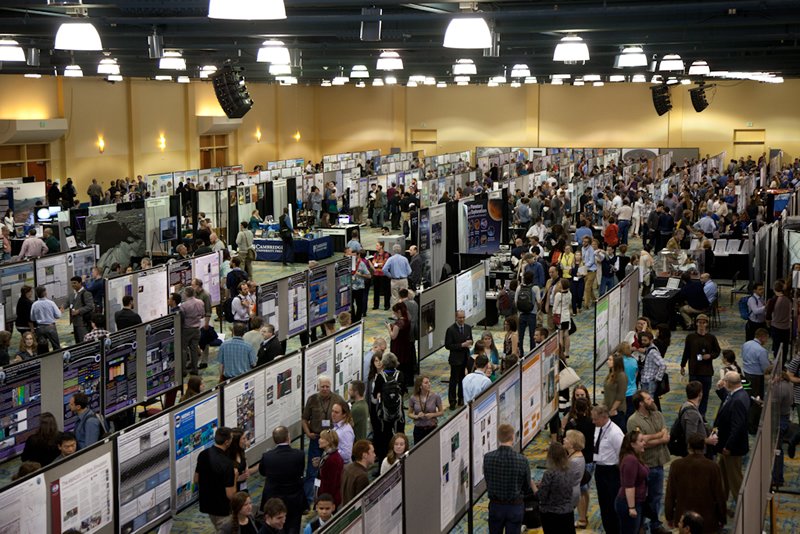
Tuesday Night Poster Session at the LPSC 2016.
I might be in there somewhere...
Image credit:  Lunar and Planetary Institute. 


This year's Lunar and Planetary Science Conference (LPSC) was another success. I again went as an independent researcher, but this time I was also looking for employment opportunities. I got a few leads, which I will follow up in the next few weeks.

I also rejoined the official LPSC microblogging crew. Some of you may have followed my short posts on Google+ during the conference. As usual, I am reproducing my entire complement of LPSC microblogs, plus appropriate links (if available), here on the Planetary Geo Log. Again, the intent is for you to digest a few small nuggets at a time. I hope to write up some of these in future blogs, so keep an eye out. If you would like to learn more about any of the posted topics, please feel free to make a request in the comments.

Sunday March 20, 2016
1)  Hello folks. I am at the Lunar and Planetary Science Conference again this year and will be microblogging on Google+. I hope you enjoy my observations of the conference.  
(http://www.hou.usra.edu/meetings/lpsc2016/)  

2)  Attended this year's #Microsymposium57 before #LPSC2016. I'll be posting some highlights......
(http://www.planetary.brown.edu/html_pages/micro57.htm)  

3)  David Paige has found that there are more volatiles in low latitude craters at the lunar poles, because those craters catch the poleward-migrating volatiles before they can reach the high latitudes of the poles. #Microsymposium57 before #LPSC2016.    

4)  Barb Cohen is looking for "operationally useful amounts of water" on the Moon, which means large quantities. She proposes this can be done using cube satellites. #Microsymposium57 before #LPSC2016.    

5)  Mahesh Anand tells us that ESA considers the Moon to be the primary target for human exploration after the ISS. #Microsymposium57 before # LPSC2016.    

6)  Tony Colaprete and Jen Heldmann told us about the proposed Resource Prospector mission. It consists of a rover that will take measurements and samples at several locations on the lunar pole. #Microsymposium57 before #LPSC.    

Monday March 21, 2016
1)  Catherine Johnson shows that the magnetic field on Mercury is strongest in the Caloris basin and the magnetic field is at least as old as the Caloris basin.   
(http://www.hou.usra.edu/meetings/lpsc2016/pdf/1391.pdf)

2)  L. Hood noted that you need a long-standing magnetic field to explain the magnetic signatures seen at Caloris and Sobkou basins on Mercury. So, Mercury would have had a magnetic dynamo at the time these basins formed.    
(http://www.hou.usra.edu/meetings/lpsc2016/pdf/1301.pdf)

3)  The models of P. James suggest that the lithosphere of Mercurry is 32 (+/-15) km thick.    
(http://www.hou.usra.edu/meetings/lpsc2016/pdf/1992.pdf)

4)  C. Fasset shows that crater degradation on Mercury happens much faster than on the Moon.    
(http://www.hou.usra.edu/meetings/lpsc2016/pdf/1046.pdf)

5)  Robbie Herrick noted that Mercury has more craters <10 km in diameter than would be expected for the number of craters >10 km in diameter. This would be due to a larger number of secondaries. If so, the oldest surfaces on Mercury could be 100 m.y. younger than previously estimated.    
(http://www.hou.usra.edu/meetings/lpsc2016/pdf/2766.pdf)

6)  Congratulations to last year's Dwornik student award winners:
      Robert Jacobson - U Tennessee,
      Hanna Susorney - John Hopkins,
      Johnathan Oulton - Florida State,
      Hank Cole - Colorado School of Mines.   

7)  Alan Stern reported on the New Horizons mission results so far. Although the flyby of Pluto is complete, only half of the data has been transmitted, because lower transmission rates were selected to keep costs down. The other half of the data is still to come. What additional exciting things will we learn about Pluto?    
(PDF Presentation of Alan Stern's Talk)
(Video of Alan Stern's Talk)

8)  Pluto has 4 small satellites in addition to Charon. The outer-most, Hydra, rotates 100 times about its axis for each orbit around Pluto. It's quite mesmorizing in this animation that Alan Stern showed.
(Animation of Pluto's Satellite's Orbits)
Comment on Google+: Wow. Any particular reason for that? (spin:orbit resonances?)
My reply: No, they're not quite sure. Just sat in on a talk by S. Porter, where they discussed the small satellites. All have retrograde rotations, which is odd, so they suspect this may be related to some kind of tidal state.

9)  Pluto's large, bright, smooth plane, called Sputnik Planum, is thought to be an ancient impact basin that is filled with nitrogen ice. This ice shows evidence of glacial flows at the northern edges according to Alan Stern.    

10)  Using GRAIL Gravity data from the Moon, Maria Zuber showed that cryptomaria (hidden mare deposits) in the Schiller-Zucchius basin do NOT extend to a depth of 10 km. This is not a surprising result, but it's good to have a confirmation of this.   
(http://www.hou.usra.edu/meetings/lpsc2016/pdf/2105.pdf)

11)  Tony Colaprete reported on LADEE data for the thin lunar atmosphere, or exosphere. Titanium and magnesium concentrations in the exosphere are somewhat correlated with mafic deposits on the surface and aluminum deposits are somewhat corelated with surface highlands, though the surface compositions cannot completely explain the exosphere compositions.
(http://www.hou.usra.edu/meetings/lpsc2016/pdf/2635.pdf)

12)  The Pluto/New Horizons research articles in Science are all open access!! Enjoy...    
(http://science.sciencemag.org/content/351/6279)

13)  S. Porter tells us that the moons of Pluto are in extremely stable orbits and their surfaces (as far as we can tell with the limited available data) are cratered and old. So, these moons are not new or ephemeral objects, but have been orbiting around Pluto for a long time.    
(http://www.hou.usra.edu/meetings/lpsc2016/pdf/2390.pdf)

14)  NASA Night at #LPSC2016. NASA is looking for community input on how we use NASA data. Foreign input is also welcome. There will be a link posted on the LPSC webpage with instructions on how to submit your input. I will update this microblog post with the link as soon as it goes up.
Instructions for submitting input can be found at: (http://science.nasa.gov/researchers/sara/grant-solicitations/nasa-request-information-assessing-planetary-science-communitys-use-planetary-science-division-facilities/)

15)  NASA Night at #LPSC2016. Cosmoquest was mentioned as one of the organizations that won an Education and Public Outreach grant this year. Congratulations #Cosmoquest!
(https://cosmoquest.org/)

16)  NASA Night at #LPSC2016. Jim Green tells us that the NASA planetary science budget got $270 million more than was requested this year!!
Total budget is $1.63 billion.    

17)  NASA Night at #LPSC2016. This was Jim Green's closing slide for questions.


18)  Really enjoyed meeting old friends and new at the Students Reception.    

Tuesday March 22, 2016
1)  Jeff Plescia told us that impact melt flows on the Moon show evidence of multiple pulses of material from the same impact.   
(http://www.hou.usra.edu/meetings/lpsc2016/pdf/2585.pdf)

2)  Jason Cook talked about the distribution of non-volatiles on Pluto. Apparently this means water, which I think of as a volatile. But water does not act like a volatile on Pluto, because of the extremely cold temperatures. Jason finds that water is widely destributed on Pluto, predominantly as fine particles.    
(http://www.hou.usra.edu/meetings/lpsc2016/pdf/2296.pdf)

3)  Misha Kreslavsky found large-scale dendritic patterns, with a topographic range of 20 meters, in parts of the lunar maria.    
(http://www.hou.usra.edu/meetings/lpsc2016/pdf/1331.pdf)

4)  Lisa Gaddis showed that M3 data can be used to identify volcanic pyroclastic deposits on the Moon.    
(http://www.hou.usra.edu/meetings/lpsc2016/pdf/2065.pdf)

5)  Tom Giguere suggests that the floor of Gassendi crater, a floor-fractured crater on the north-west shore of Mare Humorum on the Moon, shows evidence of drained lava lakes.    
(http://www.hou.usra.edu/meetings/lpsc2016/pdf/1884.pdf)

6)  Carl Allen used Diviner data, collected during a lunar eclipse, to show that pyroclastic deposits in the Aristarchus region of the Moon cool faster than other materials in sinuous rills, maria, or mare rays. The thermal inertia of pyroclastic material must, therefore, be lower, possibly due to a much finer grain size.    
(http://www.hou.usra.edu/meetings/lpsc2016/pdf/1309.pdf)

7)  Carolyn van der Bogert showed that the Dark Mantle Deposits of Taurus Littrow are actually older than the surrounding maria, even though they look younger. This is because small craters in the dark mantle deposit are in saturation and have experienced preferential degredation, while the small craters in the nearby maria are still in production, resulting in more craters at that size.    
(http://www.hou.usra.edu/meetings/lpsc2016/pdf/1616.pdf)

8)  Tuesday poster sessions were such a whirlwind, I didn't get a chance to microblog about anything.

9)  30th annual Hawaii Party was it's usual fun. Really enjoyed chatting with Tom Giguere and Steve Ruff.   

Wednesday March 23, 2016
1)  Daniel Moriarty and Makiko Ohtake presented back-to-back competing interpretations for the interior of the South Pole-Aitken basin on the Moon. I confess, I am confused....    
(http://www.hou.usra.edu/meetings/lpsc2016/pdf/1735.pdf)
(http://www.hou.usra.edu/meetings/lpsc2016/pdf/1414.pdf)

2)  Noah Petro presented work that supports the presence of cryptomare deposits in the Bhabha region of South Pole-Aitken basin on the Moon. During the question period, Apollo 17 astronaut Jack Schmidtt noted that one of the flat-floored irregular craters in the region may not be a flooded impact crater, but rather a volcanic caldera related to the cryptomare volcanism period.    
(http://www.hou.usra.edu/meetings/lpsc2016/pdf/2669.pdf)

3)  Paul Spudis identified a number of units around the edges of Mare Crisium on the Moon. These units poke through, and so pre-date, the mare material of the basin. Paul suggests that these may be remnants of the Crisium impact melt sheet and so would make good targets for future sample-return missions.    
(http://www.hou.usra.edu/meetings/lpsc2016/pdf/1463.pdf)

4)  Based on low-angle impact experiments, Pete Schultz proposes that so-called "double impacts", which have been identified in GRAIL gravity data from the Moon, may actually be due to a single low-angle impact. What happens is the approaching bolide hits the surface at an oblique angle, causing the top of the bolide to decapitate and hit the surface in a second location down-range, producing what looks like a double impact.    
(http://www.hou.usra.edu/meetings/lpsc2016/pdf/2931.pdf)

5)  Shared from Stuart Robbins.
Lisa Gaddis: NASA’s Cartography & Imaging Sciences Node contains >850TB of data, growing at ~120TB/yr.    
(http://www.hou.usra.edu/meetings/lpsc2016/pdf/2281.pdf)

6)  Just uploaded the electronic version of my #LPSC2016 poster. You can see it here...    
(http://www.hou.usra.edu/meetings/lpsc2016/eposter/2948.pdf)

7)  Pamela Gay told us about the exciting funding developments happening for the #Cosmoquest project during our Cosmoquest community meeting at #LPSC2016.    

8)  At the #Cosmoquest community meeting (during #LPSC2016), Andrea Jones encouraged us to spread the word about International Observe the Moon Night, happening this year on Oct. 8, 2016. Now is the time to start planning your event. Don't forget to register your local event, whether it's a big museum function or a small neighbourhood get together, so InOMN can highlight how global this celebration truly is! Instructions on how to get involved can be found under the Get Involved tab on the web link below.    
(http://observethemoonnight.org/)
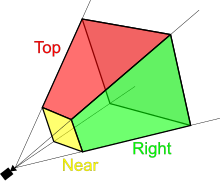
Frustum
Image credit:  Wikipedia. 


9)  New Vocabulary Word from R. Beyer's talk at #LPSC2016. Frustum: A diagram illustrating the angle a camera is pointing towards the target surface.    

10)  Planetary Spatial Infrastructure session at #LPSC2016 was very interesting. Best quote has got to be "Cartography is important to cartography." This means that Cartography, as the manipulation of digital data so that it can be presented in a map, is important to Cartography, the process of creating maps.     
(http://www.hou.usra.edu/meetings/lpsc2016/pdf/sess453.pdf)

11)  LEAG Networking Session at #LPSC2016. A group of young scientists are gathered around Apollo astronaut Jack Schmidtt, soaking up his wisdom.    

12)  Smart people tend to be more prone to unintentional bias. They tend to feel they are immune to this bias, because they are smart. So recognize that you have biases, know what they are, and work to overcome them. #WomenInPlanetaryScience and #LPSC2016.    

13)  Being self-aware of your own biases and working on those is not enough. The culture and institutions in the community need to be changed too, to help overcome this bias problem. Senior and mid-career members, who are less vulnerable, need to take the initiative in this regard. #WomenInPlanetaryScience evening at #LPSC2016.    

14)  Discussion section of the #WomenInPlanetaryScience evening at #LPSC2016. was great.    

Thursday March 24, 2016
1)  Systems engineering is ensuring that you don't design misunderstandings into your system. #NextGenWorkshop Scientists and Engineers: Learning to Work Together at #LPSC2016.    
(Video about system engineering, recommended by the presenter, Lee Graham )

2)  Think of mission requirements as dollars in a different form. You want the minimum necessary requirements to cover the scope and objectives of your entire mission, no more and no less. #NextGenWorkshop Scientists an Engineers: Learning to Work Together at #LPSC2016.    

3)  Totally amazed by the interesting people who stopped by my unconventional planetary poster about using financial modeling techniques for identifying basalt spectra.    
(http://www.hou.usra.edu/meetings/lpsc2016/pdf/2948.pdf)
(http://www.hou.usra.edu/meetings/lpsc2016/eposter/2948.pdf)

4)  The annual Arizona Party was fun, but I was too beat from my poster session to take advantage of the dance floor and DJ. Does anyone know if there was much dancing this year?    

Friday March 25, 2016
1)  Michael Nayak found that magnetic data from the South Pole-Aitken basin suggests the existence of several new magnetic paleo-poles on the Moon, which had not been previously identified.    
(http://www.hou.usra.edu/meetings/lpsc2016/pdf/2506.pdf)

2)  Lon Hood suggested that the absence of magnetization on the rims of large lunar impact basins may be due to their being erased by subsequent volcanic flooding. However, Mark Wieczorek pointed out that his earlier work shows that mare layers cool too quickly for their heat to be able to erase the magnetic signature.    
(http://www.hou.usra.edu/meetings/lpsc2016/pdf/1303.pdf)

3)  Rona Oran used simulations to model the behaviour of the lunar magnetic field during large-scale impact events. Her work shows that the magnetic field is increased all over the Moon during an impact event, not just at the antipode. However this increase is too small to explain observed magnetizations, thus supporting a stable core dynamo as their source.    
(http://www.hou.usra.edu/meetings/lpsc2016/pdf/3057.pdf)

4)  Mark Wieczorek gave a fascinating talk about the depth of lunar magnetization. Almost the entire Moon is magnetized and most of it has a deep origin. This means that impact magnetization, which only affects the surface, is not the dominant magnetizing process on the Moon. Similarly, volcanic intrusions cannot be used to explain magnetism on the far side, where volcanism is very limited. Therefore, most of the magnetization seen on the Moon must have been accumulated during slow cooling of the primordial crust in the presence of a stable dynamo. Magnetization of the farside crust would have been locked in by 230 million years after the formation of the Moon, so the dynamo must have been in place by then. This is even earlier than the oldest magnetized samples we have from the Moon, which have been dated at 4.25 billion years old (~250 million years after the formation of the Moon).    
(http://www.hou.usra.edu/meetings/lpsc2016/pdf/2288.pdf)

5)  D.A. Patthoff mapped two populations of ridges on Enceladus, one old and one recent. Based on these, the following tectonic history was proposed: compression of the crust associated with its formation, followed by a long tectonically quiet period, culminating in a recent period (<100 m.y.) of compression possibly associated with thickening of the crust due to cooling of the underlying ocean. What is not known is what are the implications of this history or the evolution of life and how long before the ocean completely freezes over.
(http://www.hou.usra.edu/meetings/lpsc2016/pdf/1772.pdf)

6)  Mike Bland proposes that the grooved terrain of Ganymede is formed when magmatic intrusions heat the overlying crust. This allows convection in the intrusion to push the overlying crust and bunch it up (like a table cloth) to form sets of parallel grooves.    
(http://www.hou.usra.edu/meetings/lpsc2016/pdf/1287.pdf)

7)  Audience request for some Game of Thrones names on Charon.   

8)  We have reached the end of #LPSC2016. Thank you so much for letting me bombard you with my observations. I hope you enjoyed it, I know I did. Until next year....    

Tuesday, 31 March 2015

Many Small Nuggets from the 46th Lunar and Planetary Science Conference

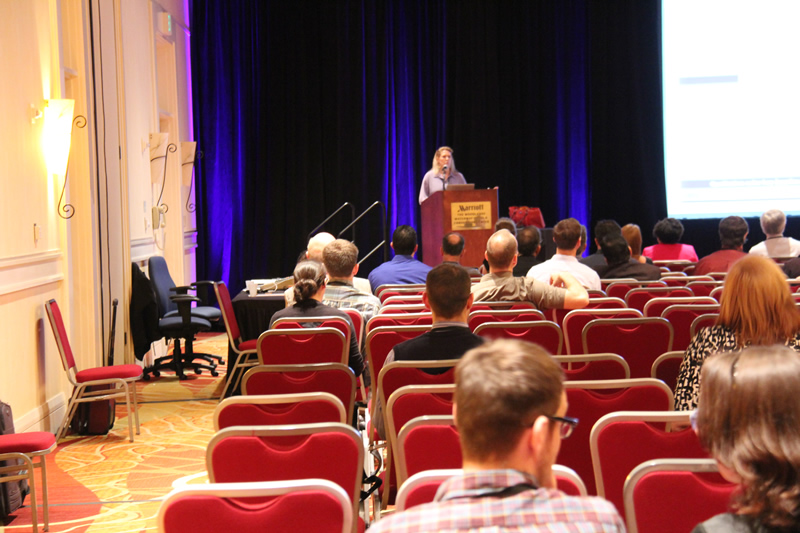
Science talk at LPSC 2015.
I was in the room, but I don't think I'm in this picture.
Image credit:  Lunar and Planetary Institute. 


This year's Lunar and Planetary Science Conference (LPSC) was fabulous. I went as an independent researcher and was pleased to see that this is no longer frowned upon like it used to be in the past. Times are tough and budgets are tight. Many scientist are looking at alternate funding models to pay for their research. So, it was wonderful to get a chance to compare notes on this front.

I also was an independent microblogger this year. For the past three years, LPSC organizers have recruited conference attendees to write short blurbs about the session talks on social media. I didn't join the official microblogging crew, but continued to post to Google+ on my own terms - I wanted to reduce the pressure I put on myself.

And just like last time, I am reproducing my entire complement of LPSC microblogs here on the Planetary Geo Log. Don't feel the need to read it all at once, but rather savour a few small nuggets at a time. I hope to write up some of these in future blogs, so keep an eye out.

Sunday March 15, 2015
1)  I am at the Lunar and Planetary Science Conference again this year and will be microblogging about it. I hope you enjoy.....
(http://www.hou.usra.edu/meetings/lpsc2015/)  

2)  The talks at Sunday's session of Microsymposium 56 were really good! Some highlights below:
     - Ejecta from the Moon-forming impact may have reached the asteroids at very high velocities, producing melts that retain a signature of the event.
     - The Procellarum basin may be a palimpsest, formed in a warm crust and mantle.
     - A Procellarum-forming impact would have melted the underlying mantle to the core and distorted the crust at the antipode, allowing later melts to migrate to the surface.
     - The South Pole-Aitken basin may have precipitated mantle melting and also distorted the the crust at the antipode, allowing melts to come to the surface in the Procellarum region.
     - Early lunar impacts may have formed before the overturn of the olivine cumulate layer in the mantle, explaining why we see so little evidence of olivine on the surface. Alternatively, the composition of the mantle may be heterogeneous.
     - Modelling of crustal relaxation for the lunar basins suggests they must have formed when the crust was warm, which is too early in the Moon's history to be consistent with a late heavy bombardment.
     - Modelling of Orientale and seismic studies of the Chixulub crater show that outer rings of multi-ring basins are associated with multiple faults (some listric) that extend all the way to the Moho.
(http://planetary.brown.edu/html_pages/micro56.htm)

3)  The LRO Data Users Workshop took place on Sunday before the LPSC. Some very useful information on how to access and work with the LRO data was presented. Slides from the individual talks can be downloaded from the workshop website.
(http://lunar.gsfc.nasa.gov/datausersworkshop.html)

4) An impromptu demonstration of the Lunar Mapping and Modelling Portal (pub.lmmp.nasa.gov/LMMPUI/LMMP_CLIENT/LMMP.html) was presented at the end of the LRO Data Users Workshop. This tool lets you view a variety of lunar data layers, all registered together.
     I suggested that the ability to do math between the layers would be a very useful addition to the tools and the presenters seemed very receptive to this idea. Maybe that functionality will be added in the future.

Monday March 16, 2015
1)  The Next Generation Lunar Scientists and Engineers panel on tips and strategies for writing successful scientific papers was very informative. The best tips (in my humble opinion) included:
     - Start with your tables and figures and write around them - use them as your outline.
     - If you are having writer's block, start writing your figure captions.
     - Writing is a two step process: dump your thoughts, then word-smith. If you are word-smithing before you have finished dumping your thoughts, you can loose your train of thought or polish something that doesn't really fit anyway, and so end up wasting lots of time.
     - Make sure your paper has only one major take-away message, since that is all that most people will take way.
     - Have your paper end by outlining the next steps; this can be helpful when applying for grants.
     - Reviewers' comments aren't absolute; you can rebut them, preferably with evidence, when you write your response.
     - Rejections often have more to do with timing - the editor doesn't think you can address the reviewers' comments fast enough for their schedule. Unless the editor encourages you to submit this paper to other  journals, consider this an opportunity to edit and resubmit to the same journal.

2)  Overheard at the Students' Reception on Monday:
"I play the stock market, because I want to be a scientist, but I also want to live in a nice house."
... We need to pay our scientists more.      

Tuesday March 17, 2015
1)  Dr. Stuart Robbins gave a fabulous talk explaining the issues with current crater chronology techniques (i.e. figuring out the age of a surface by counting craters). His talk included some amazing animations of plots (of all things) that really helped me to understand some aspects of crater dating that I hadn't before. He's shared these animations with me and I will be posting them on my blog in the near future. Stay tuned.
(http://www.hou.usra.edu/meetings/lpsc2015/pdf/2629.pdf) 

 
2)  Using simulations, Dr. Carolyn van der Bogert showed that the crater count-determined model age of a surface depends on the size of your count area. For areas that are less than 100 square kilometers in size, the model age can be incorrect, with smaller areas giving younger ages. Caution should be used when determining the age of very small areas, and multiple regions of the same unit should be aggregated to provide counts over a larger area.
(http://www.hou.usra.edu/meetings/lpsc2015/pdf/1742.pdf)

Wednesday March 18, 2015
1) LEAG Town Hall Summary  
     - Planning for a "New Views of the Moon II" is underway. Be ready to contribute to this upcoming volume (whose name is still to be determined). Contributions can also form the basis for white papers in the next decadal survey.
     - Contact your congressman about keeping LRO alive. The Planetary Society  is drafting a letter. Use this as a template for your correspondence, but personalize you letter, because studies show a personalized letter has much more impact than a form letter.
     - The next SSERVI Exploration Science Forum is this July 21-23. There will be talks streamed on the web. (http://nesf2015.arc.nasa.gov/)

2) Dr. Paul Lucey is talking about small lunar craters in the South Pole-Aitken basin. Except he keeps talking about craters in the SPA, pronouncing it "spaa" instead of "es-pee-ay", and all I can think about is getting a massage.
      Okay, I need to add that he found that small craters in SPA were almost exclusively noritic in compositions, which has implications for the composition of the mantle under SPA.
(http://www.hou.usra.edu/meetings/lpsc2015/pdf/1655.pdf)

3) Dr. S. Lawrence pointed out that GRAIL lunar gravity data does not support the presence of a basin in the Australe region of the Moon.
(http://www.hou.usra.edu/meetings/lpsc2015/pdf/2739.pdf)
 
4) Just finished giving my talk on the complexity of cryptomaria in the Mare Humorum area of the Moon. Whew! Now I can get back to microblogging.
(http://www.hou.usra.edu/meetings/lpsc2015/pdf/2808.pdf)


Thursday March 19, 2015

1) Dr. Aileen Yingst used the MAHLI camera on the Mars Curiosity rover to show that fine grained deposits in Gale crater were formed by settling from suspension. The suspension medium is most likely water, because there are no aeolian features present.
     Dr. Yingst and I talk about this some more later and further concluded that the larger grains that can be seen interspersed among the fine grains could not have been carried by wind processes, again supporting the hypothesis that these materials were deposition by settling in water.
(http://www.hou.usra.edu/meetings/lpsc2015/pdf/1378.pdf)

2) Dr. Rebecca Ghent looked at radar data of the lunar regolith and found that rocks on the surface break down and disappear within about 1 billion years. Rocks within the regolith, on the other hand, persist for long periods of time, well beyond their brethren on the surface.
(http://www.hou.usra.edu/meetings/lpsc2015/pdf/1979.pdf)  

3) A big thank you to Scott at the JMARS booth, who took time during Thursday's poster session to try and solve my JMARS issues.
(http://jmars.asu.edu/)


Friday March 20, 2015
1) Dr. H. Nekvasil conducted experiments that show how crystallization of plagioclase under high pressures can make the plagioclase more anorthitic with cooling. At low pressures, cooling plagioclase becomes more albite-rich, making it difficult to explain the high anorthite content of the lunar highlands crust. Dr. Nekbasil's work suggests the highland plagioclases could have cooled under higher pressures at depth in the lunar mantle and then been transported to the surface.
(http://www.hou.usra.edu/meetings/lpsc2015/pdf/1617.pdf) 

2)  Dr. Pete Schultz gave an amazing talk about the impact that formed South Pole-Aitken (SPA) basin. First he showed spectacular high speed movies of experimental impacts into glass spheres, which demonstrate the disruption and damage that occurs at the antipode of the impact site. These also showed that the antipode of the impact site is not the same as the antipode of the crater for oblique impacts. Next, Dr. Spudis evaluated geological features of SPA , showing that SPA is an oblique impact and that the antipode of the impact site (but not the crater) coincides with the centre of a system of tectonic features related to Procellarum. He thus concludes that the SPA impact would have disrupted the crust under Procellarum, allowing significant melts to form and migrate into the crust. These melts would have differentiated, forming a KREEP layer that was later exposed by the Imbrium impact event. Wow!
(http://www.hou.usra.edu/meetings/lpsc2015/pdf/2416.pdf)

3) One of the themes for the Moon at LPSC this year has been the composition of the lunar mantle. Considering the variety of studies and findings, it is clear that we really don't know what the lunar mantle is made of.

4) Zack Morse is doing some great work mapping the ejecta of Orientale basin on the Moon. This impact has been mapped before, but the last extensive work on this was in 1977. Zack is re-visiting these deposits using more recent data sets like the LROC WAC and NAC images.
(http://www.hou.usra.edu/meetings/lpsc2015/pdf/2608.pdf)

5) Dr. P. Boehnke pointed out that only about 50% of all lunar impact samples were heated to temperatures hot enough to reset their Ar/Ar ratios during the impact that formed them. Thus, about 50% of Ar/Ar dates from these samples will show ages that are older than the impact event. This needs to be considered.
(http://www.hou.usra.edu/meetings/lpsc2015/pdf/2745.pdf)

6) That's it. The last talk has been given. The last drink at the bar has been drunk. And the last goodbyes with old friends have been said. Farewell #LPSC2015. You were a great conference for me.
Till next year....

Tuesday, 31 December 2013

Earth or Not Earth

Earth or Not Earth
Earth or Not Earth is a new Android app for testing your knowledge of planetary features.
Image Credit: NASA with annotations by Cosmoquest.
Earth or Not Earth Game
The first game in the Earth or Not Earth app has you decide if a featured picture is from Earth or Not.
Image Credit: NASA with annotations by Cosmoquest.
This year, I got a really interesting present for Christmas. It's an app called "Earth or Not Earth" and it's available for Android phones and tablets from the Google Play Store. Brought to you by the CosmoQuest project, this app lets you test your knowledge of planetary features by (you guessed it) identifying which features are from Earth and which aren't.

Actually, there are three "games" in this app. The first one is where you have to figure out which features are from Earth. The app shows you a picture of a planetary feature, and you have to click the big "Earth" button if you think this is a feature from Earth, or the "Not" button if you think this is a picture of another planet. It's actually quite fun, and a bit harder than you think. But this is labelled as the "Easy" game.

The next "game" is labelled as medium in difficulty. Here, the app shows you a picture and you have to choose which of the 4 multiple choice answers best fits the image. The choices are usually either planets or feature types, so you need to either identify which planet the image comes from, or which kind of feature the image is showing. It's multiple choice, so it can't be that hard, right?

The final game is labelled as hard. And it is. You need to pick out two pictures that come from the same planet out of a set of 12 images. This is actually a timed activity, and you need to see how fast you can match up all the pairs in a group of 32 images.

Matching Game         Pick Two Game         Learning Cards
The second game has you pick which planet or feature type is being showcased in the image.
Image Credit: NASA with annotations by Cosmoquest.
        The third game has you pick two pictures from the same planet in a set of 12 images.
Image Credit: NASA with annotations by Cosmoquest.
        Features are described in the Learn section. (Click the "Hide" or "Show" buttons to remove or restore the text).
Image Credit: NASA, annotations by Cosmoquest, text by Irene Antonenko.
So, the app is lots of fun. But, if you find you are sucking at this, don't despair. There is a Learning section in the app that lets you explore the image set and learn more about the worlds and features in these images. Navigating either by planet or feature type, you can read about each image, what it's showing, and where it's is located. You can also "Hide" the text so you can examine the full image in more detail.    

Now, here is where I have to make a confession. You see, about a year ago, I created a set of Planetary Surface Feature "Vocabulary Cards" for the CosmoQuest project. Each card showed an image of a planetary feature and had a description of the feature and the planet it came from provided on the back. I was pretty proud of these cards, but nothing much ever seemed to come from them. Then CosmoQuest team member Joseph Moore took these cards and created this really amazing and fun app with them. So, for me, the best Christmas present was seeing my planetary surface feature cards used in this really creative and interesting way!!

If you think this app sounds like fun, why don't you give it a try. It costs only $1.99 USD and all proceeds go towards supporting CosmoQuest science research and outreach initiatives.


Sources:
Earth or Not Earth Android App, Google Play Store, Dec. 10, 2013.

CosmoQuest, Would you like to play a game with us? Google+, Dec 11, 2013.

Sanders, App Review: Earth or Not Earth, Universe Today, Dec. 20, 2013.


Thursday, 17 October 2013

The Fun of Geologic Maps!

USGS Geologic Map Excerpt
Excerpt from the geologic map of the western Winston-Salem area in
North Carolina, Virginia, and Tennessee. See the full map below, or
download it from the USGS  National Geologic Map Database.
Image Credit: USGS
Friday October 18th, 2013 is Geologic Map Day. No, really, such a thing does exist. It was founded by the US Geological Survey (USGS), the American Association of State Geologists, and the American Geosciences Institute in order to raise public awareness of the significant contributions geologic maps make in science, business, and public policy. To learn more, check out the Geologic Map Day website, where they have links to lots of neat stuff, such as geologic maps (of course), FAQs, and activities. Warning, this site is very US-centric. However, most countries have their own geologic branches of the government, which often provide on-line access to geologic maps. These can usually be found with a quick Google search. For example, the Geological Survey of India has links to a number of geologic maps throughout that country.

I think geologic maps are fun because they are so colourful. Unlike road maps, which link places with a network of lines, geologic maps look at areas. Each area is defined by the type of rock that is found there, and this rock type is shown on the map by a specific colour. This way, it is easy to tell at a glance which areas of a map have the same rock types.... and which ones don't. A legend is used to tell the map user what kind of rock each colour represents. Other geologic information, such as where faults are found, is represented by symbols, which are also explained in the legend. Some maps even come with cross sections, which show you a side view of the map at certain points, as if you had sliced the earth open like a cake and taken a look from the side. And some maps also have several paragraphs of text, explaining what happened in the mapped region, from a geological point of view.
USGS Geologic Map
Geologic map from the western Winston-Salem area in North Carolina, Virginia, and Tennessee, prepared by Rankin, Espenshade, and 
Neuman in 1972. The full map can be downloaded from the USGS  National Geologic Map Database.
Image Credit: USGS

Most people think of maps as something we make for places on the Earth. But we have been studying planets long enough that we have a fabulous assortment of maps, including geologic maps, for the other planets. The Lunar and Planetary Institute lists a bunch of links to planetary maps (and images) for the Moon, Mars, Venus, and Mercury on their Resources page.   My favourite is the Geologic Atlas of the Moon, which has links to on-line versions of every geologic map of the Moon published by the US Geological Survey.  Here you can find geologic maps for the Apollo landing sites, other regions of interest, and the entire Moon, divided up onto smaller segments.

This geologic map from 1971 (top) shows the Hadley Rille region of the Moon, where the Apollo 15 mission landed. The red lines overlaid on the map show the traverses that the astronauts undertook (determined from recent image data). This kind of information tells us that the astronauts saw a variety of geological regions on their traverse. They started out in flat mare terrain. One of their traverses skirted the ejecta of a young impact crater (olive green). Another traverse crossed the debris slopes (olive brown) of the Apennine Mountains (brown) to venture into the hills themselves. The third traverse cut through a crater field (pink), which was most likely formed by the ejecta from a much bigger crater well off the map, and then headed into the Apennine Mountains (brown) again.  In contrast, the Lunar Reconnaissance Orbiter Camera (LROC) image (bottom) does not provide this much information. The Apollo 15 traverses, shown in red, were determined from very high-resolution LROC images.
View the full map, with legend and explanations at the Lunar and Planetary Institute's Hadley Rille map page.
Explore this area of the Moon in more detail using the ActReact QuickMap Web Interface.
Examine the Apollo 15 traverses for yourself at the LROC Apollo 15 Traverse Page.
Image Credit: USGS (Map), NASA/Goddard/Arizona State University (Image and Apollo 15 traverse), and Irene Antonenko (compositing).

You can also find geologic maps for other planetary bodies in our solar system. Many haven't been studied long enough to have geologic maps made of the entire surface, but there are sections that have been mapped. Again, a quick Google search can find you lots of interesting tidbits. On a whim, I searched for "geologic map of Titan", which is one of Saturn's moons, and found an amazing little geologic map and article on the Selk crater of Titan, from The Planetary Society. Seriously, you should go check it out!

So, I hope this article has piqued your interest and inspired you to go check out some geologic maps, whether they are of Earth or any other planetary body, and celebrate Geological Map Day.